About Me

My photo
I spent the best part of the last 10 years in contracted research in the UK and The Netherlands and am now planing to settle down in Germany. But before I do that it is time for some adventure. Inspired by Rolf Potts' “Vagabonding“ I decided to have a look around in Eastern Europe and, budget permitting, around the Mediterranean sea. I will use this blog in the coming months to share my travel experiences and experiences from life on the road.

This map shows how far I have got so far. If you wonder about the different colours... blue are places where I stayed for at least one night, red markers are day trips and yellow shows my current location.

Vagabonding times auf einer größeren Karte anzeigen

Friday, 12 February 2010

"Hello friend, welcome to Istanbul"

After a total of nine nights I left Veliko Tarnovo with a very happy feeling in my stomach about what I had seen in, and learnt about Bulgaria. My plan was to go to Turkey next, Istanbul to be precise, but the only option to go there from Tarnovo was an over-night bus. Although popular with travelers (you safe time and money on accommodation) I prefer to see where I am going and so I took a 4.5 hour bus ride to Plovdiv from where there are day-time bus runing to Istanbul.

Like before in Bucharest, I made a 2-day stop in Plovdiv to make my connection to Istanbul and with the intention to have a look around town. Our bus arrived in the town centre in the evening and after about half an hour of walking I stood in front of Hikers Hostel (thanks for pointing me to them, Fedio). Yanni opened the door for me and whilst walking me through the backyard, I could already sense that Hikers was a potential traveler trap. The house and garden were very cosy and Yanni (the guy behind the bar in the photo) and company made me feel like a friend rather than just a paying guest right away.

Plovdiv is culturally and historically rich, and with Hikers being the place it was I knew it would be hard to stick to my schedule. But I did. In fact, I didn't even try to discover much of the town, knowing that I could be opening Pandora's box. Instead I spend a lot of time talking the the folks at the hostel. Some friends of the staff, travelling musicians, stayed over night and made for good conversation. One of the young rasters had started a course at university but was disliked by his professor for his looks, to the extent that passing the course became an impossible mission without changing his appearance first. So after dropping out he could have tried to get a full-time job, he explained, earning him maybe 200€ a months, bending his back for someone else to get rich, but barely enough to survive himself. Taking on a “slave job” didn't agree with his attitude however, instead he is trying to survive as a street musician and taking up the odd little job. When we were getting pizzas later that evening we could see what “slave jobs” do to people. A young and rather grumpy guy asked us what topping we want and when we said 4-seasons he snapped back at us saying that we were not in a restaurant. Sorry for asking, dude! Anyway, together with my Polish and Bulgarian companions from the hostel (latter translated the whole unpleasant scene for us later) we did manage to get some pizzas in the end and we used the waiting time to make jokes about that sad character of a pizza cook...

After two nights at Hikers in Plovdiv I boarded a Metro Plus bus to take me out of the EU and all the way to Istanbul. Passing the boarder was quite a procedure. We had to get off the bus four times: first the Bulgarians checked our passports. Following this we stopped at a huge duty free mall in the no-man's land between the Bulgarian and the Turkish checkpoint, where many of the passengers stocked up on fags...
Shopping stop in no-man's land

Then we drove a few hundred meter further to disembark again at the Turkish passport control, that didn't check the passports but just collected them all. We boarded again and then had to get of at the customs checkpoint, where the luggage got checked manually or, in case of complicated pieces with too many pockets (like my backpack), it got x-rayed. At 1.5 hours in total it was a very lengthy procedure, and a bit nerve wrecking, especially when we had to board the bus without getting our documents back first. But everything smooth: we drove on a nice motorway (something sorely lacking in Bulgaria), got our passports back, and a few hours later we reached Istanbul.


On my march from the bus station to my hostel I got some nice first impressions, but also I got hustled a lot by all kinds of dubious “friends”, offering jewellery, women, fags or try to convince me that my hostel was no good and suggested I instead follow them to their “cheap” hotel. But I kept smiling and walking... Istanbul, here I come!

Monday, 8 February 2010

Feeling home at Nomads in Bulgaria

For the last week or so I have stayed at the Nomads hostel in Veliko Tarnovo. As far as hostels go, this is a very special place. It is the home of two Bulgarians, Georgie and Fedio, who decided to share their home, cooking skills and life philosophy with traveling folk like me. They live with their guests, they live through their guests (they don't need to travel because the world travels to them) and they live because of their guests (obviously you do pay some money for the accommodation).

The homey front room at Nomads...
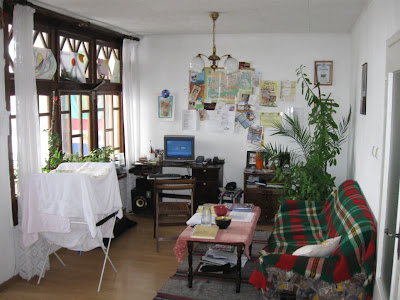
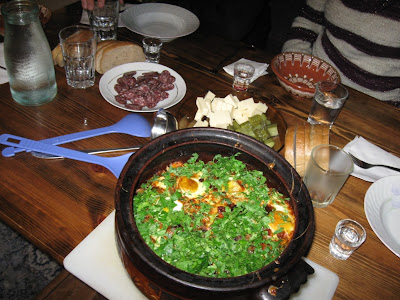
For most of the nights I was the only guest and Fedio acted as a kind of personal chef, cooking up tasty Bulgarian meals.

No matter what dish he had prepared, it was always accompanied by bread, pickles, cheese and Bulgarian salami. Similar to the tradition in Hungary, meals where started with a glass of fruit brandy. Here they call it Rakija. Ours was self-distilled and the stuff was so strong that we always had to thin it down with lots of water.
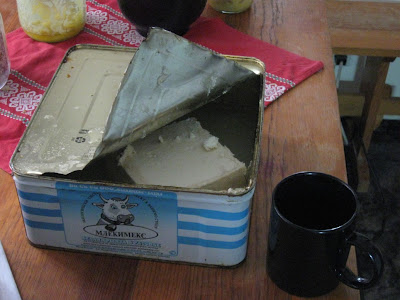
Feta cheese is so popular, it comes in huge tins. Hopefully your fridge is big enough to fit it in.
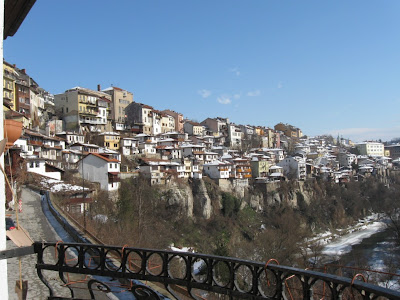
The hostel is situated on top of cliffs in the beautiful historic part of the town...
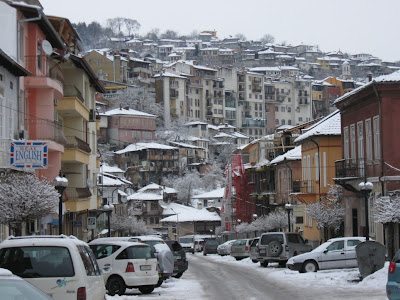
...and offered magnificent views from the balcony
Almost every evening we had friends of Fedio around. One of them was Ludmil and he explained to me that the town of Tarnovo is a miracle. According to his estimates, about 80% of the population live in survival mode, and yet the town has three big home electronics shopping centres. He reckons the only reason that they have survived the last few years is because they are a cover up for money laundring.

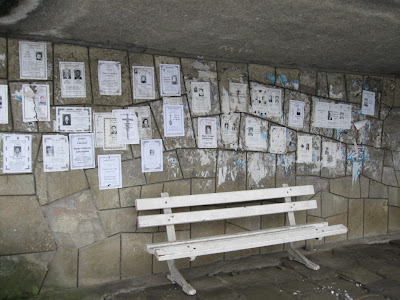
On my excursions through town I kept coming across these death notices. They could be on anything and anywhere, in groups or individually, usually however on front doors. In some streets there seemed to be so many, I started wondering if they were struggling with some deadly disease or other. When I enquired about it, my host explained to me that it is custom not just to publicly announce when someone has died, but also to re-announce the death after certain intervals (like after 40 days, 3, 6 and 9 months, 1, 2, 3 years and so on...).
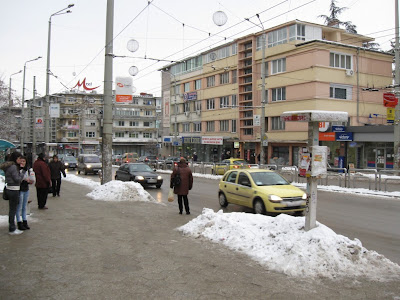
Planing public transport by bus in Bulgaria has been the most diffucult so far. Bus stops are easy to recognise (here in Tarnovo they are marked by these concrete pillars, or the standard bus signs) however there are no bus schedules to be found anywhere, they simply dont exist. At the tourist information they confirmed this for me with a “Yeah, that's the way it works here”. In the busy town centre, a bunch of people hanging around the bus stop is a good indication that there should be a bus soon, but you still don't know whether it will be the right line taking you to your desired destination. For long distance bus connections there is at least a website, and it even comes in an English version. It doesn't work with the Latin spelling of town names however (Bulgarian is based on the Cyrillic alphabet), so don't get too excited. At first I thought there simply are no bus connections to the places I wanted to visit and it took me a while to figure this out. So what you have to do is this: first you go to the website for train connections. There you can pick from a long list your departure and destination. The lists are of course in Cyrillic, so you need to have some idea what the Cyrillic writing of your destination looks like (thank goodness I had Russian classes at school!). From the next page you can then copy the Cyrillic names of departure and destination and paste them one by one into the bus connection website. Hit search and voilà, there are all your bus connections.
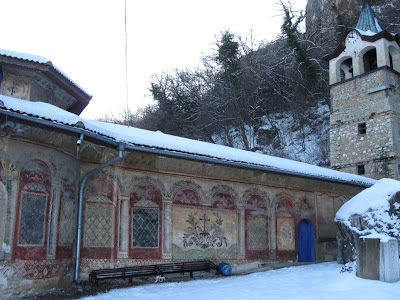
There are numerous monasteries in Bulgaria with beautiful wall paintings (this one was a 2 hour hike in the woods from Tarnovo) and it was places like this that helped religious traditions to survive the years of communism.
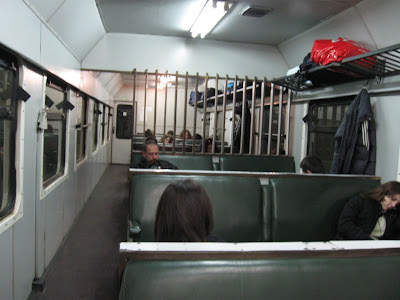
One of my day trips took me to the town of Tryavna, but the whole trip was really about using local trains. People getting off the train didnt seem to care about closing the doors behind them and being old trains as they were, without automatic door closing mechanisms, the train would just roll with the doors wide open. As a result, sooner or later it got quite cold in the train and only at that point someone would take care of the door situation. None of the doors seemed to shut properly however, there would always be a gap big enough to squeeze your hand through.

These old trains had one very nice feature though and that was those 4-person wide benches with foldable armrests, giving you plenty of space to stretch out. For my return to Tarnovo I again used a local train, but this time it was called a fast train. Since my return ticket was valid for the slow category trains only I had to pay some top-up to the conductor. The funny thing was however that it took virtually the same time as on the way down, a solid hour for a distance of just over 40km.
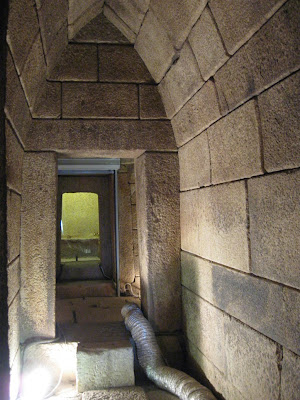
On my last day trip from Tarnovo I went to the Shipka village to have a look at a Thracian burial mound. The Thracian people inhabited the Balkan region around 2000-3000 years ago and according to my host left over 100.000 of these burial mounds in Bulgaria alone.

It was only six years ago that someone discovered a tomb inside one of these mounds. Being a snowy day in early February and at a location off the main tourist track, I stood there all by myself inside the burial chamber – and I started feeling somewhat intimidated by the place. The chamber was made from a solid 3x2x2m granite rock into which a room had been chiseled, and then it had been covered with another huge piece of granite. The imagination of finding ones final resting place in a room like this was a very unpleasant thought.
From Shipka I wanted to hitchhike back to Gabrovo, a town about half way on the way back to Tarnovo, and then take a bus from there. Before I even managed to fully stretch out my arm a car pull over. Inside was a friendly big fellow and he indicated I should get in. He was a truck driver who had just come back from a tour to Hamburg. When he mentioned Hamburg I got my map of Europe out and showed him where I come from. He got really excited then and I had to put it away again quickly because it seemed to distract him a little bit too much. We were driving on a bendy and snowy road up to a mountain pass, and he was driving rather fast as it was, way too fast for my liking given the road conditions. I was clutching to the handle above the passenger door and really surprised that we didn't skid, not even in the sharper bends. I asked him about this and he smiled at me and said that the car was a VW Syncro, a 4-wheel drive. We were virtually glued to the road in this thing. His kids had been bugging him to replace the 25 year old banger, but he felt a reliable car like this one (it had 400.000km on the clock and still its first engine) is hard replace.
My driver spoke in broken German, that is how we managed to communicate. At some point he started with politics, but communication was just too difficult for this subject. Apparently a lot of money has disappeared (“Zapp ze rapp”) during the political change, which he was not very happy about, especially as his pension, after 32 years of truck driving, will be just 60€ per month.
Despite the communication problems the ride was very enjoyable and interesting for me and so I scrapped the idea of getting off in Gabrovo and went all the way back to Tarnovo with this guy. Take care, man!

Some statistics:
distance travelled this year since leaving home: 1937km
transportation costs: 5.5cent/km
shortest wait for a hitch: 3 seconds
Sunday, 7 February 2010

Last stop Bucharest

After leaving Braşov I stuck to my plan and went to Bucharest for just two nights. It was a short stop but long enough to figure out how to get to, and where to in Bulgaria, and I still had sufficient time for a nice long stroll through the city.

My mode of transportation to Bucharest was by minibus. I would have preferred the slow, lowest category train, but there was only one option at an inhumane early hour, so I opted for the Mercedes Sprinter bus instead, spent a bit more on the fare and got to sleep in. These minibuses are very popular for long distance travel. Depending on the length of the journey there will be 10-15min breaks now and then. Our driver pulled over to a roadside diner after just over an hour where he had a hearty meal waiting for him, and every one else rushed of to the toilet or had cigarette.

I managed to get the last seat in this Sprinter and sat for 3.5h in the far left corner of the back row, talking to a Bulgarian medical doctor and a Dutch Samaritan next to me. Apparently doctors are paid so little that they ask patients for gifts (cash or otherwise) when they seek treatment. There doesn't seem to be a moral limit to it however; one local told me you can be asked to pay 1000€ for the doctor to have all the right equipment read in case there are complications during giving birth. Ouch!!!

My last post might have given the impression that the whole of Romania is one giant scrapheap, but that is not quite true. In the surroundings of Braşov I saw quite a few newly setup companies, the old town looked pretty decent and in Bucharest too there were signs of investment. In fact, the run-down and abandoned factory yards I have seen here don't really differ from some places in East-Germany (just take a train that passes through Leipzig), but the frequency of such sites is much higher here.


This shot is showing the backside of the Palace of Parliament in Bucharest, where dogs feed of the garbage dumped by locals. There was a small park that I wanted to pass through, but there were just too many dogs, some of them seemed to operate in packs, and with no other people around I opted for the street instead. When one of the dog gangs came running over to my side I got a bit nervous for a second. I didn't want to turn around though, instead I caught up with some other people and followed them at close distance. This seemed to work, the dogs ignored us and I got to keep my sandwiches this time.

The whole area where the Palace of Parliament is situated got completely “restyled” by Romania's last communist dictator Nicolae Ceauşescu. Huge housing quarters had to be demolished to build his new “concrete city”. As sick as this may seem, looking at these concrete blocks I find many of them have a lot more style than the ones I grew up in in East-Germany.

Communism did not go too well with religion. The modern concrete buildings were often placed in such a manner that the view of churches and monasteries was obstructed. I had already heard of and witnessed this practice in Warszawa, but here they seemed to have mastered it.

I had read on the internet that buying an international train ticket at the station can stretch ones patients well beyond the limit. The hostel staff however saw no need to buy my ticket to Bulgaria in advance, being the quiet winter season and all that, but since I had no plans for the evening I decided to pop over to the station anyway. I was the only customer there at the international ticket booth, and despite the fact that there were three sales women in the office behind the window it wasn't until half an hour later before I was handed my ticket. First they had some important money counting to finish and then one of them went off to get new calculators for everyone (they use them to show foreigners like me how much tickets cost). I was glad I wasn't in a rush for my train.

Check out the big bottles on the bottom shelf of the fridge. They are plastic beer bottles and come in 2l, 2.5l and sometimes even 3l. At about 35 cent for half a liter it is the cheapest drink to buy. I had quite a few already during my time in Romania. They last me for more than a day (of course!) and go flat pretty soon, but if they come chilled from the fridge, I don't care that much.

Friday, 29 January 2010

Getting stuck in Braşov

Braşov has proofed somewhat a trap as a stop-over location on my trip to the warm south. An area rich in history and with interesting architecture, mountains to climb and a very friendly hostel owner couple that is just waiting to tell you all about Romanian history and culture, I couldn't bring myself to leave after just a couple of days but stayed here for the last 9 days, trying to sample everything there is. To get back on schedule I now will have to have a very short stay in Bucharest.

View over Braşov's old town with its huge "Black Church" and the old town hall.

On Tuesday I went to see the Bran and Râşnov castles. Bran castle is tiny and picturesque and its association with Vlad Tepeş, better known as Dracula (Dracula translates as son of Dracul, and his father was Vlad Dracul (engl: Vlad the Dragon) the duke of Wallachia at his time) creates a lot of hype. I had decided not to visit the castle at the weekend in order to avoid the tourist crowds – and this part actually worked out pretty well – but what I had not considered is that all the local stray dogs could focus on just me and challenge me for my lunch. I had just gotten one of my home-made sandwiches out and before even managing one bite I found myself cornered by three of these Romanian “community dogs”. I didn't want to risk getting bitten, so I sacrificed one of my sandwiches and then walked off quickly. Next time I will check my vicinity more carefully for these buggers before getting any food out!

Râşnov castle is a massive fortress sitting on top of a mountain and thus has a very different character compared to Bran. It was temporarily closed when I got there on my way back from Bran but, resorting to scrambling, I still managed to get to the side facing the town and was able to enjoy the grand view.

Overlooking snow-covered Râşnov from the fortress. Our day time temperatures this week were around -10, and one night it even plummeted below -30 degrees.

Another of my day trips took me all the way to Biertan, one of the most important Saxon villages in Transylvania. It took a couple of train rides and hitches to reach the place, including two rides on horse carts, and so getting there and back was at least as exciting as visiting the village. Nowadays there are only few Saxons still living in Transylvania. Starting during the communist times, most of them left for Germany due to the discrimination by the Romanian state. But the Saxons are not the only ones who have left the country. In my conversations here I have learnt that the Romanians have given up on believing in economical and political change. People here talk about the revolution in 1989, but even 20 years later nothing really has changed since then other than people getting more and more frustrated. If people have an opportunity to leave the country, they will do so in order to escape corruption and poverty. This whole state of affair got sumed up for me in one sad looking scene where a station chief waved off our train, standing under a dirty, half torn Rumanian flag. After 20 years of frustration nobody seems to care any more.

Peasants with their horse carts - a common sight outside Romania's cities


The impressive fortified church of Biertan, you can see it from miles away

Statistics:
km travelled this year: 1700
cheapest 1/2l beer in a bar: 0.75Euro
dog bites: 0
friendly and helpful Romanians: lost count

Monday, 25 January 2010

A very pleasant stop-over in Budapest and entering Romania

Arriving at Budapest the first thing I did was get some Hungarian Forint from a cash machine. I was stupid enough to go for a nice round figure, 5000HUF, which came out as one single note. The exchange office didn't want to change my note into smaller value denominations because they wouldn't be earning a commission on this service. Just in front of the exchange office some dodgy looking guys were hanging around, they too were into the money exchange business. I was sure they had watched me and when I was approached by one of them I indicated that I already had sufficient funds and merely interested in smaller notes. With this knowledge I assumed the guy would just leave me alone, but he insisted on helping me. That was rather surprising since again, he would not be able to earn a dime on me, unless he is into cheating, and this made him even more suspicious. Aware of the situation I decided to be extra alert and went along and followed him to a snack shop in the station hall. He talked to the shop owner about my money problem, and seconds later I held five 1000HUF notes in my hand. The money tout just smiled at me and walked back to his spot outside the exchange office. This all was too good to be true, I thought, and started inspecting my new notes, wondering if I had become victim of a counterfeit money scam. The notes however looked alright to me and everyone accepted them without a second look. Appearances can be so deceptive!

After this first bit of excitement it was time to go and look for my host Ági who had offered to pick me up from the station. Just before arriving in Budapest I had sent a message to her, explaining she could recognise me on my blue coat and the head scarf. I was lurking around in the station hall, scanning the faces of every woman for reactions to my presence. After a minute or two I spotted a girl with a wide friendly smile and she was heading straight for me. My gut feeling told me this must be Ági, and this time my gut feeling was right!

For the next two days Ági and her friend Peter made me welcome in their house like I have been a long-time friend. They live outside Budapest in the small town of Alsónémedi, where almost every house seemed to have a nice garden and often feature a small vineyard. The next morning I took a local bus into Budapest and sorted out my onward ticket to Brasov, Romania for the day after. Without any fixed arrangements for the remainder of the day (they only thing clear was I would stay for a second night) I used the time to visit Budapest's Memento Park, a open air museum where the “remains of communist dictatorship”, the statues from Hungary's communist period are on display. In the evening I headed back to Alsónémedi and found out that Peter's parents were expecting us for dinner. It was cold outside and the roads icy so we took Peter's car for what seemed not more than 1km journey, skidding through the streets. At his parents a big pot of goulash with galuska (Hungarian style gnocci) awaited us. However, before you start the meal it is custom to have a shot of palinka to boost your appetite. When I was getting ready for my second serving of goulash Peter signalled that there are two more dishes waiting to be sampled, and so I made it a small portion. The next dish up was paprikás krumpli, a dish made from potatoes and spicy sausage, flavoured with lots of paprika. This was followed by túrós tészta, a dish made from cottage cheese and pasta. I put a portion on my plate and Peter's dad mixed it for me with the right amount of sour cream, salt and sugar. This last dish didn't feature any paprika and did a great job in reducing the heat in my mouth. Before we left for home Peter's mum made me a big lunch pack for my long journey to Brasov. Starting with the palinka, the wine, pickled paprikas and even the spicy sausage in the potato dish, everything served that night was home-made. The language barrier made direct communication with Peter's parents difficult, but I hope they could feel from my body language how much I appreciated their hospitality.

I was pretty much the only visitor at the Memento park. The cold and snowy weather just added to the feeling that no one is missing the old communist relicts.


This T-shirt is being sold at the Memento Park, and for those in doubt, it made absolutely clear that Memento Park is not about romanticizing the old commuist days.

After a long feast of Hungarian home-made food and drinks

The next morning Peter's dad came by the house. He was on his way to Budapest for work and he gave me a ride back to the Keleti train station, where Ági had picked me up two days ago. In these last two days I felt fully submerged in local life and culture, something you don't find – at least not to the same extent – when you stay at hostels. I still haven't used couch-surfing yet, but I got the feeling that I shouldn't wait much longer and start writing couple of emails to potential hosts.

On Tuesday morning I board the IC 435 which provides a direct connection between Budapest and Bucarest. The train was virtually empty but this changed when we get closer to the Hungarian-Romanian border. In Békéscsaba the platform was bustling with Romanian traders who had come over to Hungary to buy cheap supplies. Every single one seemed to have at least 20 large shopping bags. As soon as the train had come to a halt they started rushing to the doors. They only had 3 minutes to get all their stuff on the train and it was a mad display of people running back and forth between the train doors and their bag depots on the platform. A few of the guys must have been through this ordeal before, they had organised a cart for their bags and so they could just bring them all up to the doors in one go. The final stop in Hungary is Lökösháza, no one boarded there but the Hungarian police came through the train checking passports of every one. I had to hand mine to a female border police officer with an excessive amount on make-up in her face. She stared at me for what seemed like minutes, checking if my face matched the photograph in my passport, and then went on to inspect every single page of my passport before she was pleased. A little bit further down the track at our first stop in Romania the Romanian police came through the train but these guys were way more relaxed, the passport check only took seconds.

Thanks to the generousity of my Hungarian hosts I got to enjoy this for lunch whilst waiting for the border crossing formalities to complete.

Entering Romania from the north-west, I was shocked about the sudden change of how everything looked. There were tons of derelict factories and abandoned company yards, and everything that had not yet been abandoned looked like it is going to collapse any time soon. There was garbage everywhere and instead of seeing tractors on the fields farmers used horses and carts. I remember thinking that passing the border felt like entering a different world, a world hard to believe to be a member of the EU. In Arad, the first Romanian city that we passed, two Romanians joined me in my compartment. Minutes later we were already discussing the poverty (the average income is 200€, but many prices match or even exceed those back home) and corruption issues of Romania, and with a few short interruptions and changing passengers this discussion only ended 7 hours later when I arrived at my destination, Brasov. For the next few days this would be my travel base for exploring Transylvania (German: Siebenbürgen), an area influence by German settlers that followed an invitation by the Hungarian king in the 12th century to inhabit these lands.

The very first stop in Romania, things still looked pretty "normal" here...


...but further down the track this was a much more common display.

Friday, 22 January 2010

Getting to Budapest


It is Sunday morning and I already managed to get to Dresden. I am waiting for the EC171 train. Coming from Berlin, it will take me via Praha and Bratislava to Budapest, my first stop on the way to the Middle East. The train is very spacious and virtually empty and I check whether I accidentally boarded a 1st class coach. I am happy when I find that I am indeed in 2nd class and that I had not bothered with a seat reservation. If you can plan at least three days ahead, it is amazing how little you pay for these international train connections. The whole 815km from Dresden to Budapest only cost me 29€! The first section of the 9 hour journey is particularly scenic because the train follows the river Elbe which is cutting its way through the Elbsandsteingebirge.

Part of my travel gear is a portable fridge. It really is just a vacuum flask in which I stick a frozen gel-pack, but it does the job of providing cooling for my temperature sensitive medication rather well. About half way through my journey I head down to the restaurant cart, hoping that they have a freezer in which I can recharge the gel-pack. After some gesturing I manage to convince the guy in the cooking section that my flask is not a bomb but a device that my health depends on and he is happy to help me with my cooling problem.

Despite an engine problem somewhere in the Czech Republic we arrive with only 30 minutes delay in Budapest. Here at the station I will meet up with Ági, a friend of a good friend who was kind enough to invite me to stay with her for a couple of days before pushing on south into Romania.

For most of the 9 hours of the train ride I had all this space to myself.

Although the only goal of this first leg was getting to Budapest, taking the day train meant I got to fully enjoy the nice scenery along the way.

Saturday, 16 January 2010

Picking up my route again

After my time in Poland I managed to do a bit more traveling in Hungary and Slovenia, but after just four weeks some domestic affairs made me opt for another short interruption of my vagabonding experience. Without being fully in control of matters, that short interruption turned into quite a long break from what I actually had planed on doing.

Early December it finally looked as if I could start traveling again. But I had a problem now. More than two months had passed and the outlook of snow and ice made me wonder whether picking up my trail in Slovenia and meandering from there via Ex-Yugoslavia into Transylvania (which was my original idea for continuing) still made sense. So I got a map and some climate charts and after some studying I decided I should instead concentrate on Turkey and the Middle East. Using public transport to get there, I could choose my route and still see a bit of, at least, Romania and Bulgaria before reaching Turkey, and it would also link this forthcoming vagabonding episode geographically to my travels from last year.

I started with some travel research, sent my passport off for a Syrian visa (apparently Jordan and Lebanon issue visa on entry), bought my first digital version of a Lonely Planet guide (being able to do a text search is just fantastic!) and then, just after getting my passport back the snowy road conditions forced me of my bicycle (thanks to a rather daft maneuver on my part). To cut it short, I managed to injure my foot and this meant I had to wait another couple of weeks before backpacking became an option again. But this latest delay also had a positive side; I got to spend a few days around New Year with a bunch of close friends and we had a truly awesome time.

And this takes me to the presence: I am fully eager to get going, my foot has sufficiently recovered, I am half packed and have one more day to sort the final bits and pieces. On Sunday I'll catch a train to Budapest, and from there I'll get another one to Romania. I have planed to spend a few nights there and in Bulgaria, before heading to Istanbul and beyond. Depending on how things go I will visit at least Syria, Lebanon and Jordan and then return home in April and start looking for work.

Some impressions from Hungary...

Boat spotters, or more likely they are just enjoying the view over Budapest ;)


Delicious local wines and foods at the annual Budapest wine festival. It venues in the castle grounds which just adds to the whole experience. The Tokaj was a wee bit sweet for my liking, although the pickles made more than up for it.


No matter what age, many Hungarians still mourn the loss of land that came with the peace treaties after WWI & WWII.


...and some impressions from Slovenia: with emerald-green rivers and high soaring mountains it is a paradise for outdoor lovers...


In the mountain resort of Bled I came across this vending machine for, you guessed it right, MILK! You can choose between small and large bottles and you even get to fill them yourself!